

Web scraping used to be a more casual affair: Robotic Process Automation (RPA) routines created on a write-once, run-many basis – humans recording their browsing actions, refining them through various automation processes, and setting them to run at intervals, unattended, in order to obtain data from websites that only want real humans (or paying clients) accessing them and their data – and which take measures to repel automated browsing of this kind.
Of course, domains subject to this treatment often considered RPA to be more akin to ‘data exfiltration’ and/or ‘hacking’ than any definition of ‘browsing’. Prior to the current era of AI, web scraping emerged from obscurity quite rarely, as a marginal form of pest; until LinkedIn launched an ultimately-doomed lawsuit against HiQ Labs, an ‘intelligent automation’ provider, and one of many corporate concerns that challenged LinkedIn’s right to harvest publicly, profit privately.
Since publicly-available data has become a truly valuable resource for AI companies (rather than the insipid ‘Data is the new gold’ rhetoric of ten years ago), at least 60% of reputable sites have been found to be repelling an AI crawler – a rise (in 2025) from 23%, two years earlier.
Fool Me Twice…
In practical terms, defending against any kind of web scraper is about pattern-matching, and looking for evidence of algorithmic access, such as screenshotting non-selectable text, or polling the CSS stylesheets, or the other underlying structures of a page.
These actions in themselves, no matter who or what executes them, are often considered evidence of automated processes rather than human interaction; personally – and especially at Yandex – I often have to complete CAPTCHAs because I make ‘uncommon’ or technical queries; and the more protective and protected domains are generally intolerant of anything but ‘mom ‘n pop’ baseline browsing behavior.
However, that’s still a relatively rare and heavy-handed experience. For the most part, anti-scraper logic and algorithms are looking not so much at the actions as for the way they are enacted – and especially for repetitive usage patterns for keyboard and mouse interaction. This could mean that a played-back RPA human interaction that works at first will shortly become blacklisted, because its lack of variation reveals it over time as a routine, and not a person.
Because of the growth of AI scraping, the tools of the RPA industry have suddenly become of great interest both to AI and intelligence companies that consider publicly available data ‘fair game’ in spite of any interstitial defenses (a stance theoretically supported by LinkedIn’s defeat in the aforementioned lawsuit – at least in the US); and the defending domains that in most (but not all) cases don’t have quite enough market capture to retain their profitable user base behind a login-wall, and would prefer to keep access open.
In the latter case, the companies have hardened themselves against the customary dedicated ‘headless’ browsers common in RPA, and against dedicated RPA frameworks such as Microsoft’s Playwright, and its derivatives and forks.
Going Dark
The security sector has taken an interest lately in whether AI-powered web agents can actually still be recognized by sites that are on the defensive against such activities. After all, these incursions may not be running on a CRON job, but neither are they ‘human’.
In this regard, a new paper† from Canada proposes an AI-powered web agent designed to test the effectiveness of current anti-bot defenses. By combining a modified version of Chromium with AI models trained to reproduce human mouse and keyboard activity, the new system achieved access (non-rejection of browsing) in 89% of tests on a benchmark of protected websites – 12 percentage points above the best previously-published result:
Comparative test results for bypassing eleven categories of web bot protection. Figures indicate successful page access as percentages, with test counts in parentheses. The new paper’s system, DarkAgent, achieved the highest overall score across 80 tests, compared with previously published results for nine other browser configurations. Source
The system, dubbed DarkAgent, consists of Browsium, a customized Chromium browser engineered to conceal evidence of automated control; and Behavium, a framework incorporating two machine learning models: MouseGen, and KeyboardGen, which, together, simulate human interaction with the browser:
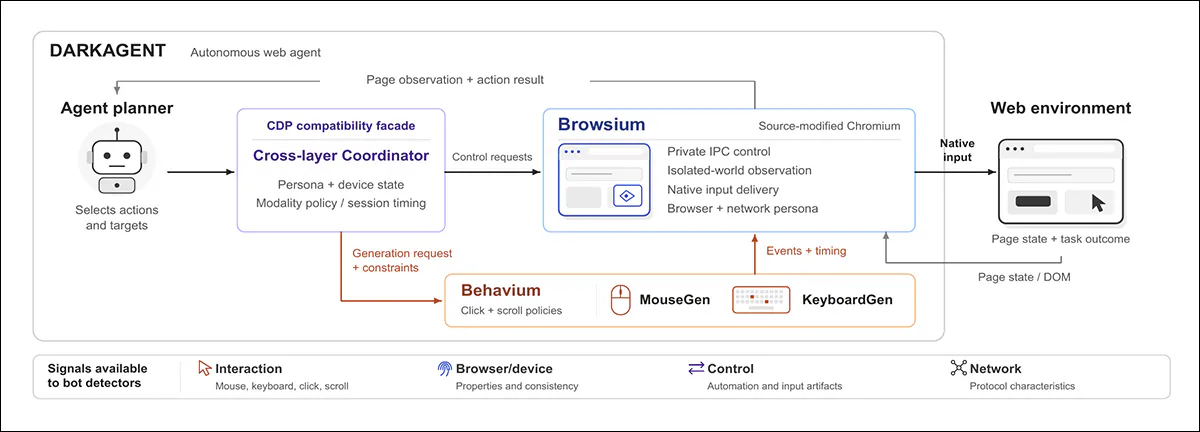
The DarkAgent workflow. Browsing decisions are translated into simulated human interactions, executed through Browsium’s native input mechanisms. The resulting page changes are fed back to the planning agent to determine its next action.
The architecture, shown above, addresses four categories of evidence available to bot detection systems, namely interaction patterns; browser and device characteristics; evidence of automated browser control; and network protocol characteristics.
The aforementioned KeyboardGen was trained on the Aalto keyboard dataset, derived from a study of 136 million keystrokes, to reproduce typing rhythms, errors and corrections. MouseGen was trained on the Boğaziçi Mouse Dynamics dataset, with additional scrolling data sourced from the Attentive Cursor dataset:
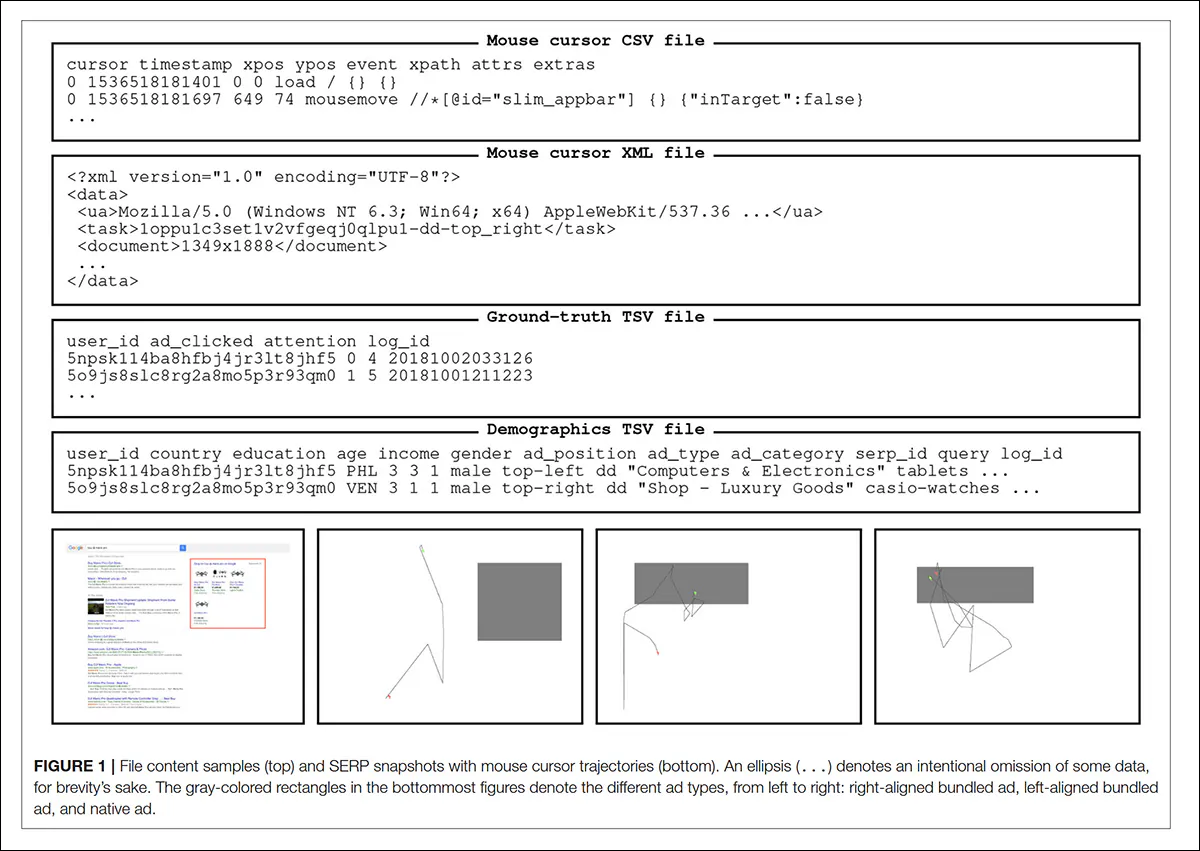
Examples of mouse movements, in coordinate and interpreted form, from the Attentive Cursor Dataset. Source
Both generators use Transformer architectures, while the browser modifications were implemented through conventional programming. OpenAI’s GPT-4.1 was used to decide which actions to perform during the benchmark tests.
The browser’s reported identity and the simulated user behavior are coordinated throughout each session, so that the various signals presented to a website remain consistent with one another. To support this, a separate JavaScript-based environment within Chromium allows the agent to inspect web pages without exposing its presence to the website’s own scripts:
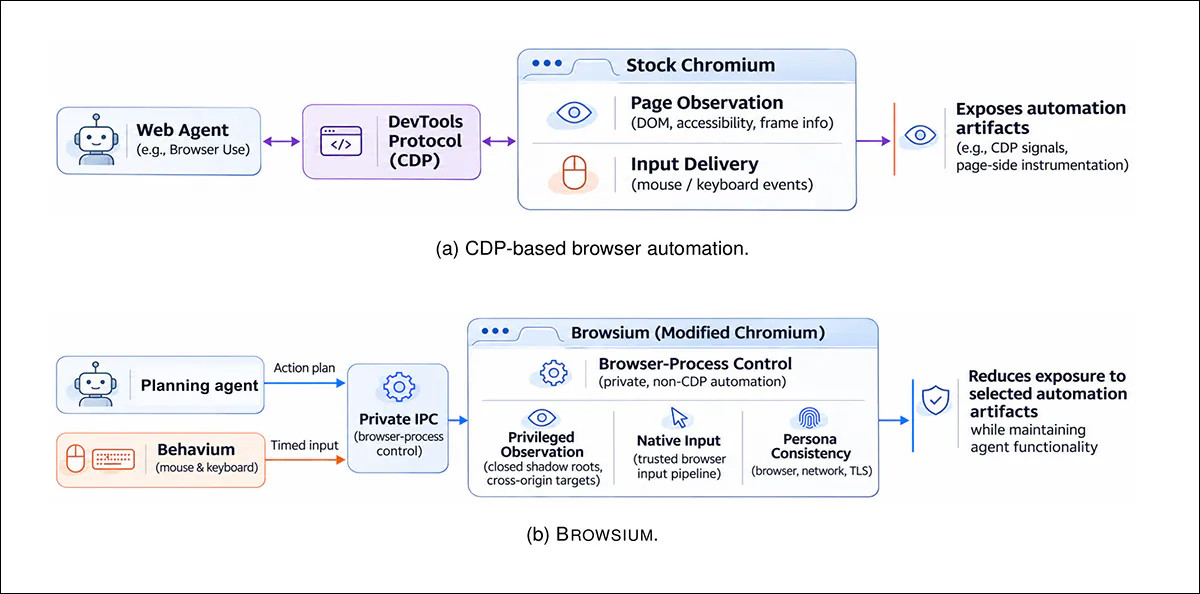
Comparison of conventional browser automation (top), using the Chrome DevTools Protocol (CDP) to inspect and control web pages, and the new paper’s approach (bottom), where a private communication channel reduces the evidence of automated activity visible to websites.
The simulated mouse movements and keystrokes are then processed by the browser as genuine user input, with the same trusted status granted to physical mouse and keyboard activity. Variations in mouse trajectories and typing patterns, learned from recorded human activity, facilitate different sequences of movements and actin timings, reflecting the natural inconsistencies of human interaction.
Results
DarkAgent was evaluated using Stealth Bench V1, a benchmark developed by Browser Use, comprising 80 short mouse and keyboard tasks on live websites, requiring no login and covering eleven categories of protection: Cloudflare; PerimeterX; DataDome; Akamai; reCAPTCHA; Kasada; Shape; GeeTest; hCaptcha; Temu; and (unspecified) site-specific anti-bot systems.
The tests were conducted in August 2026*, using geographically-matched residential proxies, with success measured solely by whether page access was obtained, and discounting task completion. Comparative results were drawn from earlier baseline tests conducted by the benchmark’s authors.
To establish the individual contributions of DarkAgent’s components, 30 browsing sessions were scheduled for each of 18 configurations on a website hosted by the researchers, with identical prompts, tasks, planning models, and limits on the number of actions.
For this, standard Chromium and Browsium were tested with and without Behavium, and with MouseGen and KeyboardGen enabled independently.
Additional comparisons were made with Firefox; Camoufox; the Playwright derivative Patchright; CloakBrowser; and publicly-available human behavior simulators Ghost Cursor; HumanTyping; and CloakBrowser’s Humanize.
The browsing sessions were evaluated using FP-Agent (an existing bot-detection system); additionally, JA4DB (a database of network connection fingerprints) was used to check whether the browser’s reported identity was consistent with its network activity.
Beyond the initial Stealth Bench V1 results presented earlier, all browsing sessions conducted without behavioral simulation were identified as automated by FP-Agent, while every session conducted with Behavium enabled in either Chromium or Browsium was classified as human:
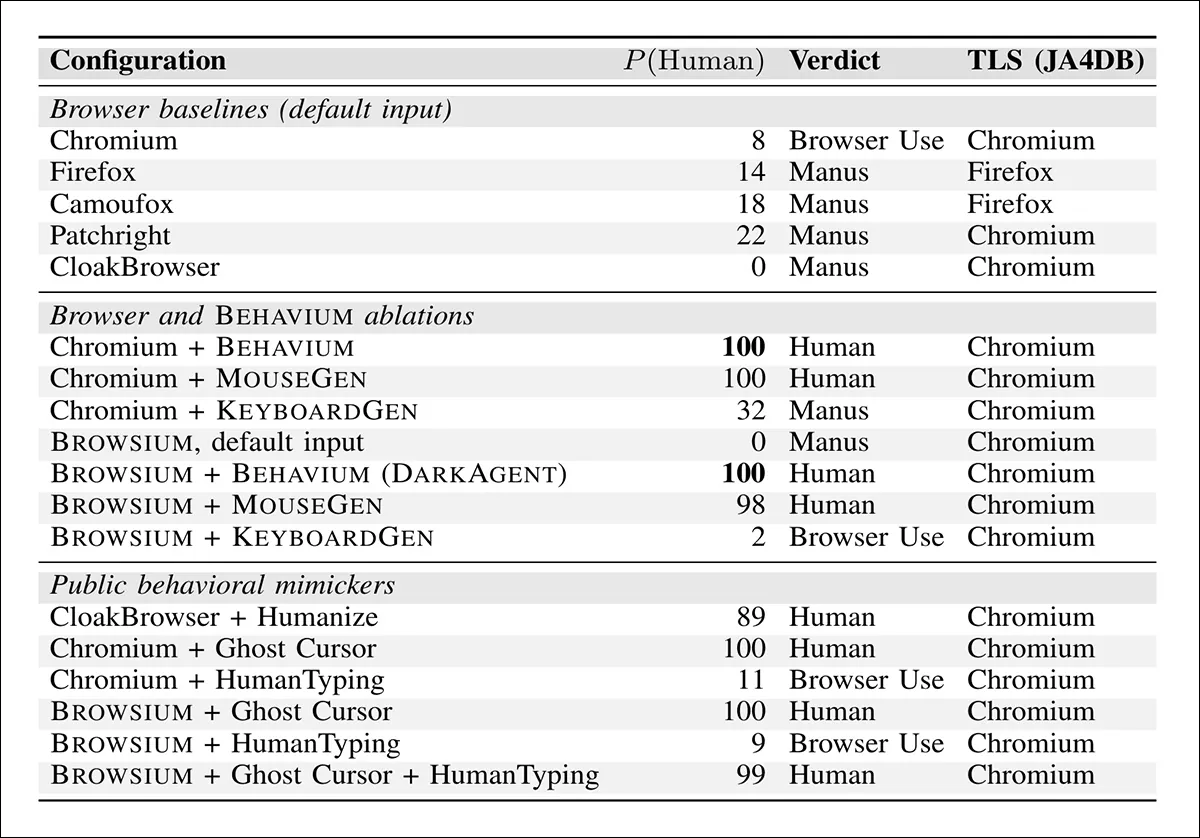
Bot detection results across 18 browser configurations, based on 30 sessions per configuration. P(Human) indicates the average probability of human activity assigned by FP-Agent, Verdict indicates the most frequent classification, and the final column identifies the browser engine inferred from the network connection.
Similar results were obtained with Ghost Cursor and CloakBrowser’s Humanize, indicative of a weakness in FP-Agent (which doesn’t examine how fast the mouse moves, or how its speed changes).
In AgentShield tests, all 139 form-filling sessions from the benchmark’s existing automated agents were flagged as bot activity, as were all ten sessions conducted with Browsium using standard automated input. With DarkAgent and CloakBrowser + Humanize, all ten trials per configuration were completed successfully without detection:
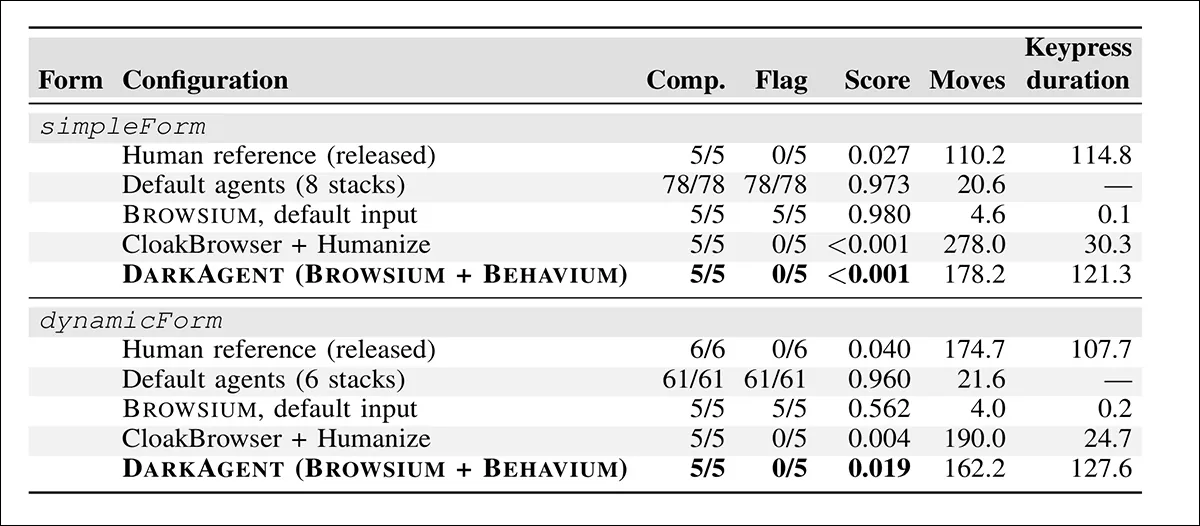
Results of the AgentShield form-completion tests, showing successful submissions, bot detection rates, detection scores, mouse movements and keypress durations. DarkAgent and CloakBrowser + Humanize escaped detection, though DarkAgent’s keypress durations were considerably closer to those of human users.
When new fields appeared in the form, they were attended to by DarkAgent within an average of 3.74 seconds, compared to 4.72 seconds for human users. The greater variation in human response times suggests, the authors contend, that bots could still be identified by the length and consistency of the pauses between actions.
Conclusion
Although this almost-impenetrable paper is not likely to gather many adherents to the cause, web scraping is one of the most interesting challenges for the dataset-builder and proponent of agentic AI.
However, it’s fast-becoming a Quixotic pursuit; even sites that may be indifferent to data acquisition routines are now likely to become defended against RPA and agentic AI in the very near future, simply because it is becoming a default position.
While data of the kind dealt with in this research can be extracted from human engagement farms in Asia, such data will inevitably form recognizable patterns in the aggregate, so that the routines that are part of them can be specifically blocked – a familiar pattern in a new cold war that’s starting to heat up.
Projecting the scenario to an extreme, truly effective RPA countermeasures could signal the wholesale revival of the crowdsourced worker – lately an eclipsed figure.
† Titled ‘Are Web Agents Still Detectable? Stress-Testing Bot Defenses with Coordinated Evasion’.
* Relevant only because GPT4.1 was available then.
First published Thursday, November 26, 2026


